
Why Most Small Businesses Lose Federal Proposals
Why Most Small Businesses Lose Federal Proposals
(And How to Fix It)
There’s a hard truth in federal contracting that most small businesses aren’t told early enough:
You don’t lose at the proposal stage.
You lose before the proposal ever starts.
By the time you’re writing, the outcome is often already set.
The proposal is not where you figure things out, it’s where you prove what you’ve already built.
The Shift Most Small Businesses Need to Make
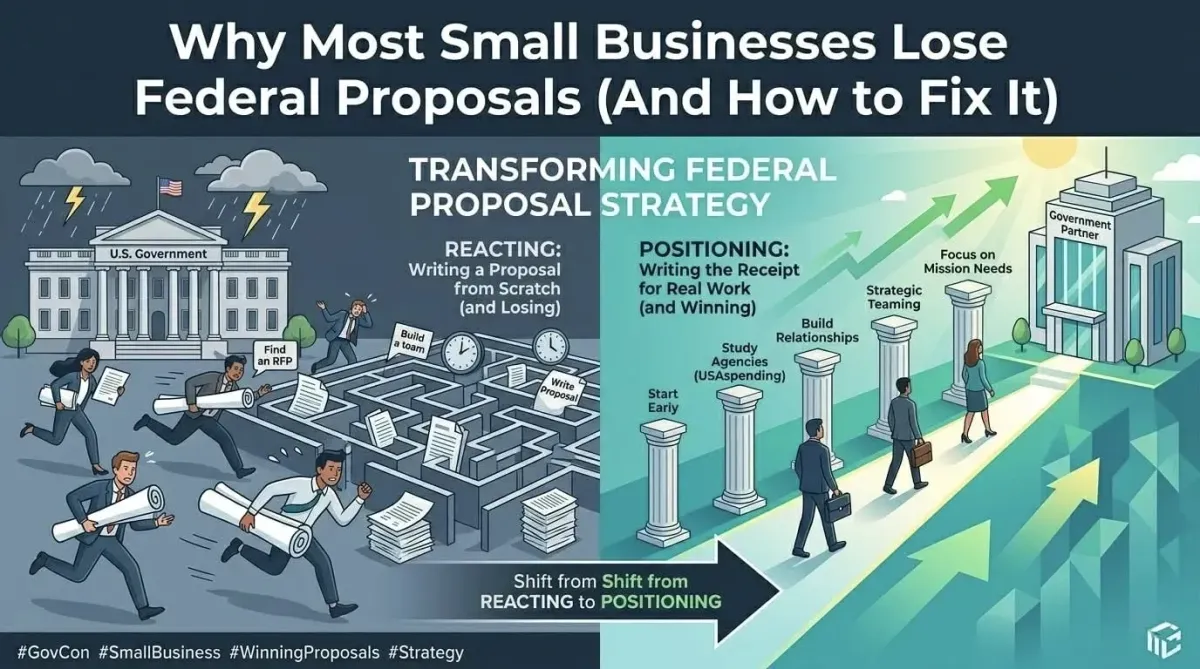
A lot of businesses approach federal opportunities like this:
Find an RFP
Build a team
Figure out the solution
Write the proposal
That approach feels productive, but it’s backwards.
Winning companies do it differently:
Identify target agencies early
Study spending patterns (USAspending, forecasts)
Build relationships before the requirement is finalized
Align services to real mission needs
Assemble teams strategically
Then write the proposal
That’s the difference between reacting and positioning.
The Proposal Is Just the Receipt
Think of your proposal as a receipt for the work you’ve already done.
It should reflect:
A clear understanding of the agency
A solution that makes sense for their environment
A team that fills capability gaps
A pricing approach that’s been thought through
If you’re building those things during the proposal window, it shows.
And evaluators can tell the difference immediately.
Why Strategy Beats Writing Every Time
Many small businesses focus heavily on proposal writing, and that matters.
But writing alone won’t win if:
Your solution doesn’t align with the mission
Your past performance doesn’t match the work
Your team feels thrown together
Your pricing doesn’t reflect market reality
Strong writing can’t fix weak positioning.
But strong positioning makes writing easier and more effective.
Where Most Proposals Actually Win or Lose
There are two sections that carry more weight than most people realize:
1. Executive Summary
This is your first impression and often your most important one.
It should clearly answer:
Why this agency
Why this requirement
Why your team
If it reads like a compliance checklist, it won’t stand out.
2. Solution Narrative
This is where you connect your capabilities to the agency’s mission.
It should feel:
Intentional
Specific to that customer
Easy to follow
Generic language is one of the fastest ways to lose evaluator attention.
Clarity Is a Competitive Advantage
A common mistake is trying to “sound federal.”
That usually leads to:
Overly complex language
Long, dense paragraphs
Unclear value
But evaluators are reading under pressure.
They are looking for proposals that are:
Easy to navigate
Easy to understand
Easy to score
The simpler and clearer your proposal is, the stronger it performs.
Write for the Evaluator, Not for Yourself
Every section of your proposal should make the evaluator’s job easier.
Ask:
Can they quickly find what they need?
Are we directly answering the requirement?
Is our value obvious without interpretation?
If they must work to understand your proposal, you’re creating friction.
And friction costs points.
What This Means for Govpreneurs
If you’re building a federal contracting business, this is where to focus:
1. Start Before the Opportunity
Use tools like:
Agency forecasts
Understand who buys what you sell and why.
2. Build Your Positioning First
Get clear on:
Your core services
Your target agencies
Your differentiators
This becomes your foundation for every opportunity.
3. Be Intentional About Teaming
Don’t wait until the RFP drops.
Build relationships with:
Prime contractors
Complementary small businesses
Potential subcontractors
4. Treat the Proposal as the Final Step
By the time you’re writing, you should already know:
Your solution
Your team
Your pricing direction
The proposal is just where it all comes together.
Bottom Line
Winning proposals don’t start with writing.
They start with strategy.
The businesses that win consistently aren’t better writers, they’re better prepared.
And when preparation meets the right opportunity, the proposal becomes much easier to execute.