
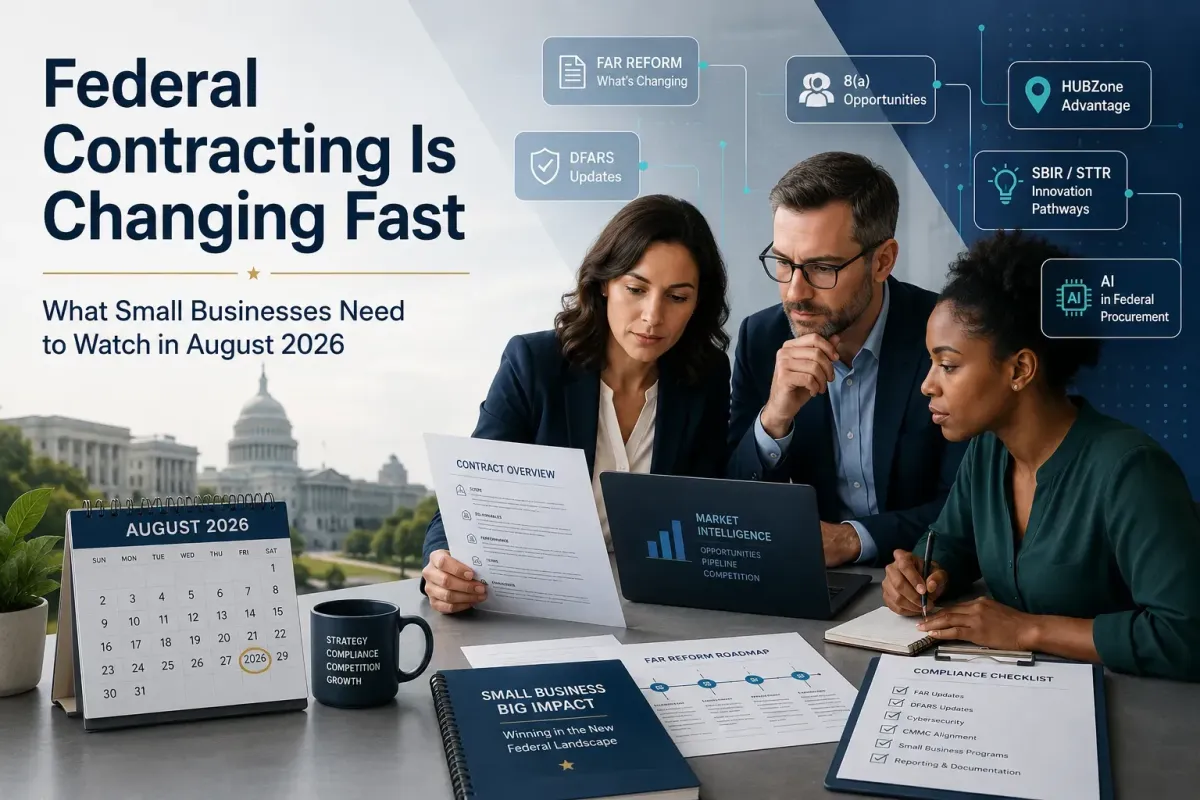
Federal Contracting Is Changing Fast: What Small Businesses Need to Watch in August 2026
Federal contracting has always required businesses to keep up with regulatory change. In 2026, however, contractors are dealing with something broader: changes to the rules, acquisition processes, small-business programs, and the way agencies are approaching procurement itself.
For small businesses, this is not simply a compliance issue.
These changes can affect how you identify opportunities, how you position your company, how you evaluate a solicitation, and ultimately whether you should bid at all.
Here are several developments federal contractors should be watching now.
The Revolutionary FAR Overhaul Is Moving From Concept to Implementation
The Revolutionary FAR Overhaul, or RFO, continues to reshape the Federal Acquisition Regulation.
The FAR Council and Office of Federal Procurement Policy are working through a comprehensive restructuring intended to simplify the FAR, return regulatory requirements more closely to statutory requirements, and move some acquisition guidance outside the regulation itself.
But contractors need to understand an important point:
There is not simply one new version of the FAR that every agency began following on the same day.
Much of the overhaul has been implemented through agency class deviations. The FAR Council specifically states that model deviation language does not apply to an agency until that agency issues its own deviation.
That means contractors may encounter differences depending upon the agency, FAR part involved, and timing of the solicitation.
The FAR Council has also moved into formal rulemaking. Multiple RFO FAR cases were published as proposed rules during 2026, while agency deviations continue to operate during this transition.
What this means for contractors
Do not rely solely on a clause library or proposal template created a year ago.
Before responding to a solicitation:
· Review the FAR provisions and clauses actually incorporated into that procurement.
· Determine whether the agency has issued a relevant RFO class deviation.
· Check the solicitation instructions rather than assuming previous agency procedures still apply.
· Update internal compliance matrices and proposal templates as the rules evolve.
The solicitation in front of you remains the controlling document for your response.
Defense Contractors Have an Additional Layer: DFARS
Companies selling to the Department of Defense have another consideration.
DoD is participating in the FAR overhaul through class deviations, but defense contractors must continue evaluating the FAR together with the Defense Federal Acquisition Regulation Supplement (DFARS) and other DoD-specific acquisition requirements.
That is especially important for contractors working in areas such as cybersecurity, supply chain management, technical data, domestic sourcing, and national security requirements.
A company may understand the broader FAR change correctly and still miss a DoD-specific requirement.
For defense contractors, compliance reviews should increasingly ask:
What does the FAR require, what has DoD changed through deviation, and what additional DFARS requirements apply to this particular procurement?
That three-part review should become part of the bid decision process.
The 8(a) Program Is Going Through Significant Policy Change
The SBA’s 8(a) Business Development Program remains one of the most important federal contracting programs for qualifying small businesses, but contractors should pay close attention to the current rulemaking.
In 2026, SBA proposed removing the longstanding rebuttable presumption of social disadvantage for individually owned 8(a) applicants and replacing it with a fact-based, race-neutral standard for demonstrating social disadvantage.
The change is intended to align the program with recent litigation affecting the 8(a) program.
This is more than an administrative adjustment.
Businesses considering 8(a), current participants, consultants, and teaming partners should be careful about relying on older explanations of eligibility.
What companies should do
Review current SBA guidance before making assumptions about:
· Eligibility
· Ownership and control
· Social disadvantage documentation
· Representations in federal systems
· Teaming strategies involving 8(a) participants
And remember that a proposed rule and a final rule are not the same thing. Contractors need to know what is proposed, what is currently effective, and when a final change takes effect.
HUBZone Eligibility Deserves Another Look
HUBZone is also an area businesses should revisit in 2026.
SBA periodically updates HUBZone designations, and certain redesignated areas reached expiration milestones in July 2026. Governor-designated areas and qualified disaster areas can also change during the year.
For a small business, that creates both risk and opportunity.
A company that previously assumed it was outside a HUBZone may now want to check again. Likewise, an existing HUBZone-certified business should not assume that a geographic designation remains unchanged indefinitely.
SBA’s HUBZone program continues to offer access to HUBZone set-aside and sole-source contracting opportunities for qualifying businesses, and the federal government maintains a 3 percent prime contracting goal for HUBZone firms.
That makes geographic eligibility worth monitoring—not merely when applying for certification, but as part of longer-term federal market strategy.
SBIR/STTR Has Been Reauthorized Through FY 2031
One of the most important developments for innovative small businesses occurred in April.
The Small Business Innovation and Economic Security Act reauthorized the Small Business Innovation Research and Small Business Technology Transfer programs through Fiscal Year 2031.
For technology companies, researchers, manufacturers, and companies developing dual-use capabilities, this creates a much longer planning horizon for one of the federal government’s primary small-business innovation pathways.
SBIR and STTR should not be viewed simply as research grants.
For the right company, they can serve as an entry point into an agency, provide funding to mature technology, create federally relevant past performance, and position a business for follow-on contracting or commercialization.
Companies developing capabilities in areas such as artificial intelligence, advanced manufacturing, cybersecurity, autonomy, health technology, energy, space, and defense applications should understand which federal agencies operate SBIR/STTR programs and where their technology aligns with agency mission requirements.
AI Is Becoming Part of the Acquisition Environment
Federal contractors have spent considerable time discussing how AI can help companies write proposals.
That is only one side of the issue.
Artificial intelligence is increasingly becoming part of the government’s broader acquisition and operational environment as agencies evaluate how AI can support analysis, workflow, program management, market research, and mission delivery.
For contractors, this raises a different set of questions.
Can your organization explain how AI is being used?
Can you validate AI-generated proposal content?
Are employees inadvertently putting controlled, proprietary, procurement-sensitive, or customer information into public AI systems?
Can your proposal team distinguish between using AI to improve productivity and allowing AI to introduce unsupported claims or compliance errors?
The companies that benefit most from AI will probably not be the ones that simply generate proposals faster.
They will be the companies that create governance around how AI is used.
What Federal Contractors Should Do Now
With this many changes occurring simultaneously, contractors do not need to chase every announcement.
They need a system for determining which changes affect their business.
A practical August review should include:
1. Review your FAR and DFARS clause library.
Make sure internal references have not become outdated.
2. Track agency-specific deviations.
Particularly for the agencies you actively pursue.
3. Revisit your proposal templates.
Old representations, certifications, clauses, and compliance language should not automatically roll into new proposals.
4. Strengthen your compliance matrix process.
Every solicitation should be evaluated against its actual instructions, evaluation criteria, clauses, attachments, and deviations.
5. Verify your small-business certifications and eligibility.
Pay particular attention to changing 8(a) and HUBZone requirements.
6. Reassess your sole-source strategy.
Certification alone does not create a sole-source opportunity. Agencies still need acquisition justification, market intelligence, capability evidence, and a defensible procurement strategy.
7. Validate your capture assumptions.
If your strategy was built around an acquisition method, set-aside, incumbent position, certification, or contracting vehicle that has changed, your capture plan may also need to change.
8. Establish rules for AI-assisted proposal work.
Determine what information can be entered into AI systems, who verifies outputs, and how your company prevents fabricated or unsupported content from reaching a proposal.
The Bigger Issue: Federal Contractors Cannot Operate on Autopilot
The lesson from the current contracting environment is not that businesses need to become regulatory attorneys.
It is that federal contractors need to become better at recognizing change.
A business can have an excellent capability statement, strong past performance, the right NAICS codes, and even the right customer—and still lose ground because it is pursuing the market based on last year’s assumptions.
Federal contracting is moving toward an environment where companies will need to connect regulation, acquisition strategy, market intelligence, compliance, and capture much earlier in the business-development process.
That is especially important for small businesses.
You usually do not have the staff or resources to absorb the cost of pursuing the wrong opportunity.
The goal is not simply to know that a FAR rule changed.
The goal is to understand:
Does this change affect how my customer buys?
Does it affect my eligibility?
Does it change what I have to submit?
Does it create a new opportunity—or eliminate an assumption my strategy was built around?
Those are the questions that turn regulatory awareness into competitive intelligence.
Federal contracting isn’t standing still.
The businesses that respond fastest will not necessarily be the ones reading the most updates.
They will be the ones that know which changes matter and what to do about them.
Official Resources
Revolutionary FAR Overhaul — Acquisition.gov
The FAR Council’s central resource for rewritten FAR parts, agency deviations, implementation materials, and rulemaking updates.
SBA 8(a) Business Development Program — U.S. Small Business Administration
Current program and certification requirements.
SBA HUBZone Program and HUBZone Map — U.S. Small Business Administration
Current geographic eligibility and certification information.
Small Business Innovation and Economic Security Act — April 13, 2026
Reauthorized SBIR/STTR through Fiscal Year 2031.