
How DoD (DOW) Contracts Are Really Won
How DoD (DOW) Contracts Are Really Won
(And Why Most Small Businesses Miss It)
The Department of Defense is the largest buyer in the world, spending hundreds of billions each year.
But here’s what most small businesses get wrong:
They’re showing up at the wrong time.
By the time a contract hits SAM.gov, the opportunity is already well underway, and in many cases, largely shaped.
If your strategy starts at the RFP, you’re not competing on equal ground.
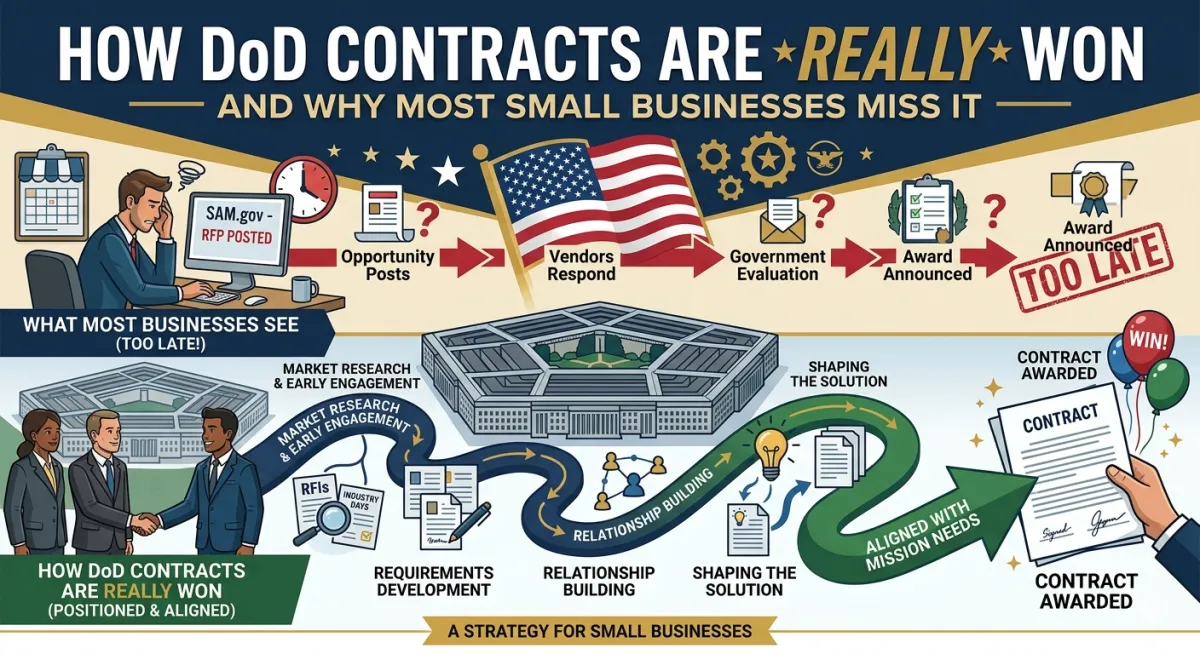
What Most Businesses See vs. What’s Actually Happening
From the outside, federal contracting looks straightforward:
Opportunity posts
Vendors respond
Government evaluations
Contract is awarded
But that’s only the visible portion of the process.
Behind the scenes, there are multiple phases where the real decisions are influenced long before the solicitation is released.
By the time you see the opportunity:
The need has already been defined
Research has already been conducted
Requirements have already been shaped
Conversations have already happened
That’s why so many businesses feel like they’re “close” but never win.
The RFP Is Not the Starting Line
One of the biggest mindsets shifts for Govpreneurs is this:
The RFP is the announcement, not the beginning.
Most companies wait for the solicitation to appear.
Winning companies:
Engage during early market research
Participate in RFIs
Attend industry days
Build relationships with program offices
Position their solution before requirements are finalized
By doing this, they’re not reacting to the opportunity, they’re aligned with it.
Where Contracts Are Actually Influenced
There are two critical phases most small businesses overlook:
1. Market Research & Early Engagement
This is where agencies:
Explore solutions
Talk to vendors
Understand capabilities
If you’re not part of this phase, your solution may never be considered.
2. Requirements Development
This is where the scope gets written.
And here’s the reality:
The way the requirement is written often determines who can realistically win.
If your approach, capabilities, or model are reflected in that requirement, you’re positioned.
If not, you’re trying to force a fit after the fact.
Why Relationships Still Matter (A Lot)
There’s a tendency to think federal contracting is purely transactional.
It’s not.
Program managers, contracting officers, and technical teams:
Need to reduce risk
Prefer known, credible vendors
Look for proven capability
That’s why relationships, built over time, play a major role in outcomes.
Showing up for the first time at proposal stage doesn’t give them enough confidence.
The Five Mistakes That Cost Businesses Contracts
Across the board, the same issues show up:
No prior engagement with the agency
Treating every RFP as a must-bid
Weak or irrelevant past performance
Underestimating compliance requirements
Trying to pursue opportunities without a strong team
None of these are proposal problems.
They are positioning problems.
Small Business Advantage If You Use It Right
There are real advantages built into the system for small businesses:
Set-aside programs
Targeted contract pools
Innovation pathways like SBIR/STTR
But those advantages only work if you:
Understand where you fit
Target the right agencies
Build a strategy around those lanes
Otherwise, you’re competing broadly instead of strategically.
What a Winning Approach Actually Looks Like
Winning in the DoD space is not fast, but it is predictable.
A strong approach looks like this:
Build Your Pipeline
Identify target agencies and programs
Engage through RFIs and industry events
Start building relationships
Understand how budgets and programs operate
Shape and Position
Share insights and white papers
Demonstrate your capabilities
Align your solution to mission needs
Become part of the conversation
Compete with Advantage
Respond to opportunities where you’re already known
Leverage past performance and relationships
Submit proposals that reflect prior alignment
At that point, your proposal is no longer a guess, it’s confirmation.
Bottom Line
The DoD does not reward speed.
It rewards preparation, positioning, and persistence.
Most businesses compete at the point where the process becomes visible.
The ones that win are active long before that.
For Govpreneurs
If you take one thing from this:
Stop chasing opportunities. Start building positioning.
Focus on:
A small number of target agencies
Consistent outreach
Strategic engagement before the RFP
Opportunities where you have a real path to win
Because by the time the opportunity is public…
You should already be in the conversation.