
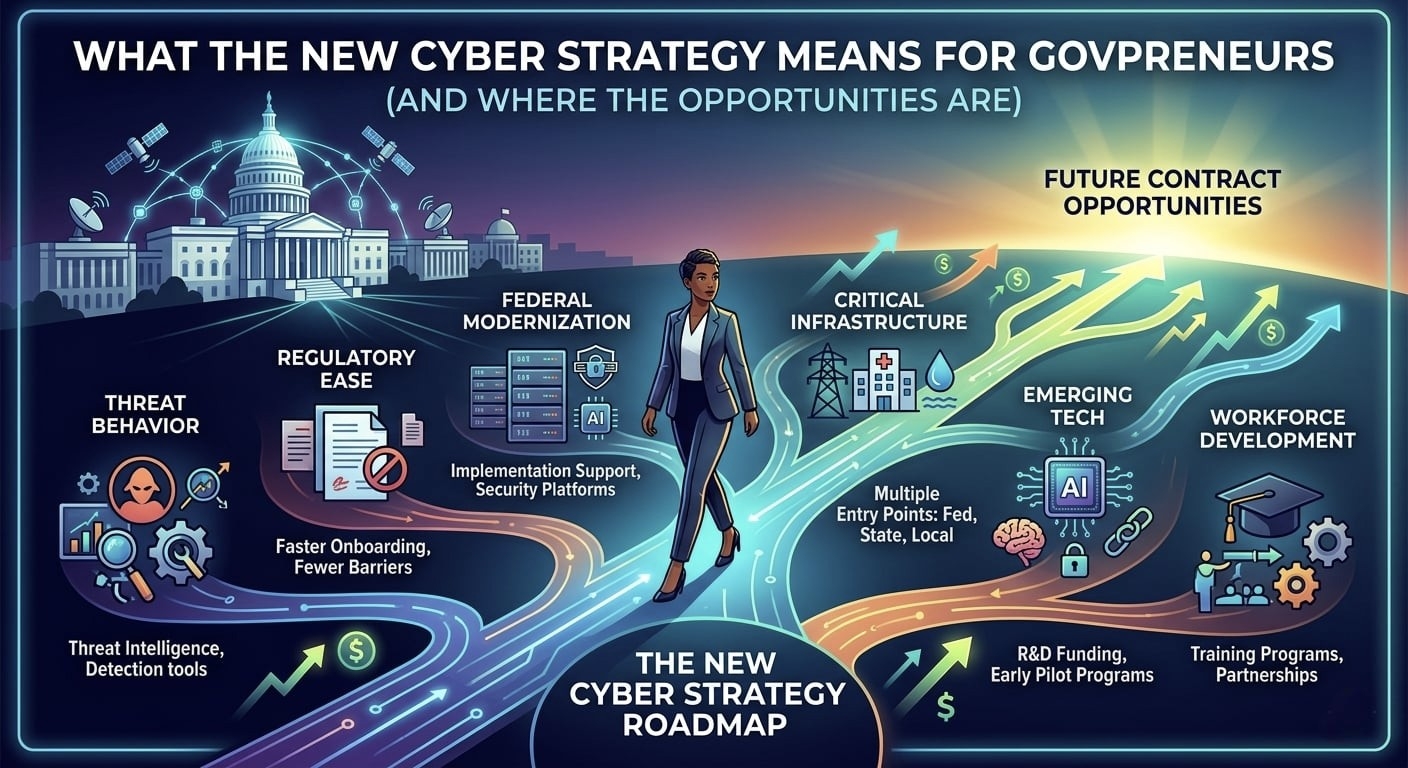
What the New Cyber Strategy Means for Govpreneurs
What the New Cyber Strategy Means for Govpreneurs
(And Where the Opportunities Are)
The White House recently released a new national cyber strategy built around six core pillars.
At a high level, it focuses on:
Strengthening national cybersecurity
Countering foreign cyber threats
Expanding both defensive and offensive cyber capabilities
Increasing coordination between government and industry
But for Govpreneurs, the real question is:
Where are the opportunities and how do you position early?
Because just like any major federal shift, this isn’t just policy.
It’s pipeline.
The Bigger Signal: Cyber Is Now a Whole-of-Government Priority
This strategy makes one thing clear:
Cybersecurity is no longer confined to IT departments.
It now touches:
National defense
Critical infrastructure
Financial systems
Healthcare
Energy and utilities
Supply chains
And importantly, it reinforces that government cannot do this alone.
There is a clear expectation that:
Private companies will play a larger role
Innovation will come from outside government
Partnerships will expand across sectors
That’s where small businesses come in.
Pillar 1: Shaping Adversary Behavior
Demand for Advanced Capabilities
The strategy calls for both defensive and offensive cyber capabilities to deter threats.
What this means in practice:
Increased investment in threat detection and response
Expansion of cyber intelligence and monitoring tools
Greater collaboration with private sector providers
For Govpreneurs, this opens lanes in:
Threat intelligence
Cyber monitoring and analytics
Incident response support
AI driven detection tools
This is not just IT, it’s mission aligned security work.
Pillar 2: Streamlining Regulations
Faster Access If You’re Ready
One of the more overlooked signals is the push to simplify cybersecurity regulations.
The goal:
Reduce unnecessary compliance burden
Align requirements with real world threats
Improve coordination between regulators and industry
For small businesses, this could mean:
Faster onboarding
Fewer barriers to entry
More flexibility in how solutions are delivered
But only for companies that already understand federal requirements and can move quickly.
Pillar 3: Federal Network Modernization
Immediate Technology Demand
The federal government is prioritizing:
Zero trust architecture
AI powered security tools
Post quantum cryptography
This is a major signal.
Agencies will need:
Implementation support
Integration services
Cyber tools and platforms
Ongoing monitoring and maintenance
There is also a clear push to make it easier for vendors to bring solutions into government environments.
That creates opportunity, but also competition.
Pillar 4: Critical Infrastructure
State and Local Entry Points
Cybersecurity is expanding beyond federal systems into:
Energy grids
Water systems
Hospitals
Telecommunications
Financial infrastructure
And importantly:
State, local, and tribal governments are part of this effort.
For Govpreneurs, this creates multiple entry points:
Federal contracts
State and local partnerships
Public private coalition models
This aligns directly with broader trends toward decentralized responsibility and shared execution.
Pillar 5: Emerging Technologies
Where Future Contracts Will Be Built
The strategy places strong emphasis on:
Artificial intelligence
Quantum computing
Advanced cryptography
Secure blockchain systems
This is where future requirements will come from.
Companies that position early in these areas will have an advantage when:
Pilot programs emerge
R and D funding expands
New contract vehicles are established
This is not just about capability, it’s about being part of the conversation early.
Pillar 6: Workforce Development
Hidden Opportunity
Cyber workforce shortages are now a national priority.
The strategy calls for:
Training pipelines
Collaboration between government, academia, and industry
Upskilling current workers
This creates opportunity beyond traditional contracts:
Training programs
Workforce development initiatives
Public private partnerships
Grant funded programs
For many small businesses, this can be an easier entry point into the ecosystem.
The Executive Order: Expect Action, Not Just Policy
Alongside the strategy, an executive order targets:
Cybercrime networks
Fraud schemes
Enforcement actions
Agencies are now expected to develop implementation plans tied to each pillar.
That means:
More solicitations are coming.
What Govpreneurs Should Do Right Now
Don’t wait for the RFP.
This is a positioning moment.
1. Identify Your Lane
Where do you fit?
Cyber tools
Consulting
Infrastructure support
Workforce development
Emerging tech
2. Target the Right Agencies
Look at:
DHS
DoD
CISA
Energy
HHS
State and local partners
3. Start the Conversation Early
Respond to RFIs
Attend industry days
Connect with program offices
Share insights and capabilities
4. Align to the Mission
Don’t sell services, solve problems tied to:
Threat reduction
Infrastructure protection
System modernization
Workforce gaps
Bottom Line
This strategy is more than a policy announcement.
It’s a roadmap for where federal cybersecurity spending is going.
The businesses that benefit most won’t be the ones who react later.
They’ll be the ones who:
Understand the direction now
Position early
Build relationships ahead of the requirements
Because by the time these opportunities are fully visible…
The groundwork to win them will already be in motion.