
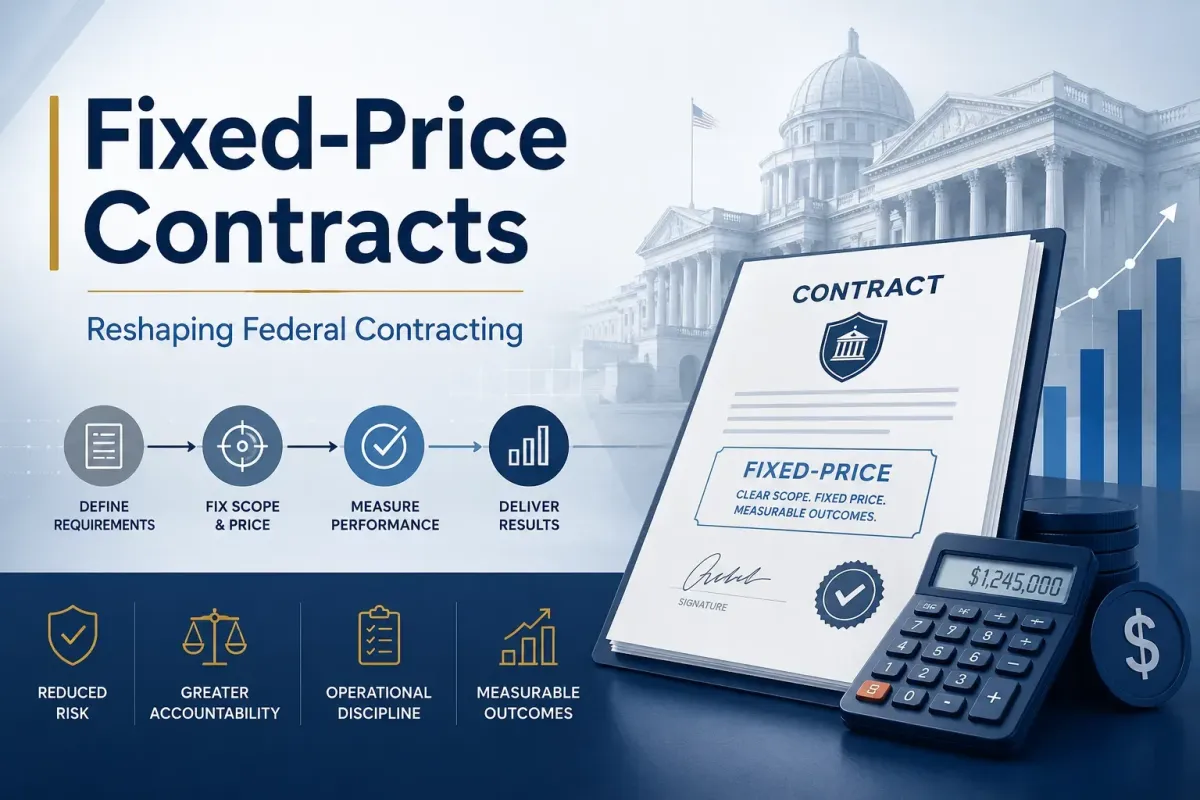
Fixed-Price Contracts in Federal Contracting
Fixed-Price Contracts Are Reshaping Federal Contracting — And Many Contractors Are Not Ready
For years, many federal contractors operated in environments where labor hours, cost reimbursement, and flexible scopes helped absorb uncertainty during project execution.
That environment is changing quickly.
Across federal agencies, fixed-price contracting is becoming a far larger part of the acquisition landscape — and with it comes a major shift in how contractors must think about pricing, proposals, execution, and operational risk.
This is not simply a pricing change.
It is a business model change.
The government is increasingly moving toward contracts that prioritize:
measurable outcomes
predictable budgets
reduced oversight
performance accountability
operational efficiency
transfer of execution risk to contractors
For contractors that still rely on loose pricing structures, unclear scopes of work, or reactive proposal development, this shift can create serious financial and operational problems.
The businesses that adapt early, however, may find themselves in a much stronger competitive position over the next several years.
The Government Is Buying Outcomes — Not Just Labor Hours
One of the biggest changes happening in federal procurement is the move toward outcome-based acquisition strategies.
Agencies are increasingly asking:
What measurable result will this contractor deliver?
Can the contractor execute within the proposed price?
Does the contractor fully understand the scope?
Can the contractor manage operational risk?
Is the pricing defensible and sustainable?
This is especially visible in:
IT modernization
cybersecurity
cloud migration
disaster recovery
logistics
environmental services
construction
facilities management
training and professional services
AI implementation support
Under fixed-price contracting, agencies are no longer simply evaluating how many labor hours a contractor proposes.
They are evaluating whether the contractor can successfully deliver a defined outcome at a defined price.
That changes everything.
Why Agencies Prefer Fixed-Price Contracts
From the government’s perspective, fixed-price contracts offer several advantages.
They help agencies:
reduce contract administration burdens
simplify budget forecasting
improve audit defensibility
reduce exposure to cost overruns
streamline acquisition oversight
hold contractors accountable for performance outcomes
In an era of tighter oversight, growing procurement scrutiny, and increased pressure to demonstrate efficiency, fixed-price contracting aligns well with broader federal acquisition priorities.
This trend is also connected to the government’s increasing use of:
Performance-Based Acquisition (PBA)
milestone-driven contracting
measurable service-level agreements
enterprise modernization initiatives
operational performance metrics
As a result, contractors must now think more like operators and less like simple bidders.
The Biggest Misunderstanding About Fixed-Price Contracts
Many contractors believe the greatest risk in fixed-price contracts is pricing too low.
In reality, the larger risk is often poor scope definition.
A contractor can submit an excellent price and still lose money if:
deliverables are vague
assumptions are unclear
government dependencies are not addressed
staffing needs are underestimated
subcontractor risks are ignored
timelines are unrealistic
acceptance criteria are poorly defined
A clean price on a fuzzy scope is still a losing contract.
This is where many small businesses struggle.
The issue is not always the pricing itself.
The issue is failing to understand the operational complexity behind the work.
Proposal Strategy Must Change
Many proposal teams still approach fixed-price opportunities using structures originally designed for cost-type contracts.
That approach no longer works well in today’s procurement environment.
Under fixed-price contracting, successful proposals must demonstrate:
complete understanding of the scope
disciplined pricing methodology
operational maturity
risk management capability
clear deliverable management
execution transparency
The strongest contractors are no longer just submitting technical narratives.
They are presenting operational execution strategies.
The Rise of the Basis of Estimate (BOE)
One of the most important concepts contractors must strengthen is the Basis of Estimate (BOE).
A strong BOE explains:
how pricing was developed
what assumptions support the estimate
what historical or market data was used
how staffing levels were determined
what operational factors influence cost
This matters because agencies increasingly evaluate whether pricing is realistic and sustainable.
Weak pricing logic raises concerns about:
execution risk
staffing capability
performance reliability
contract viability
Many small businesses still price emotionally, competitively, or based on guesswork rather than operational data.
Under fixed-price contracts, that becomes dangerous.
Fixed-Price Contracting Requires Operational Discipline
One of the biggest mindset shifts contractors must make is understanding that proposal development and operational execution can no longer function separately.
In many companies:
business development writes the proposal
accounting develops pricing
operations sees the contract after award
That model creates major problems under fixed-price environments.
Today’s successful contractors integrate:
capture strategy
pricing
staffing
subcontractor planning
quality control
project management
risk assessment
before the proposal is ever submitted.
This operational alignment is becoming a major differentiator in competitive procurements.
Milestone Payments and Deliverable Pricing Are Becoming More Common
Another important trend is the movement away from billing based purely on labor periods.
Agencies increasingly want:
milestone-based payments
acceptance-driven invoicing
deliverable schedules
measurable progress tracking
This impacts:
contractor cash flow
staffing management
project scheduling
subcontractor coordination
internal financial planning
Contractors that fail to manage cash flow properly under fixed-price structures can experience serious operational strain even on profitable contracts.
Risk Management Is Becoming a Competitive Advantage
The contractors performing well in today’s environment are the ones actively identifying and pricing operational risk.
That includes evaluating:
inflation exposure
labor shortages
supply chain disruptions
cybersecurity compliance
subcontractor performance
government approval delays
access restrictions
permitting timelines
travel fluctuations
weather disruptions
Strong proposals increasingly include clear explanations of:
assumptions
dependencies
risk mitigation strategies
performance controls
corrective action processes
This demonstrates operational maturity and builds evaluator confidence.
Small Businesses Still Have a Major Opportunity
Despite the increased complexity, this shift may actually create strong opportunities for well-positioned small businesses.
Many large contractors:
move slowly
carry high overhead
struggle with niche execution
rely on rigid internal processes
Smaller contractors that:
understand their niche deeply
manage scope tightly
communicate clearly
build repeatable delivery systems
understand operational execution
can compete very effectively in fixed-price environments.
The key is discipline.
The Contractors That Will Win Moving Forward
The federal market is increasingly rewarding contractors that can:
define outcomes clearly
manage operational risk
price strategically
execute consistently
demonstrate accountability
align proposals with measurable performance
The businesses that continue treating proposals as paperwork exercises may struggle as this transition accelerates.
The contractors that think like operators, however, may find themselves exceptionally well-positioned for the next generation of federal procurement.
Because in today’s market, winning the contract is only part of the equation.
The real competitive advantage is proving you can deliver profitably, predictably, and successfully under pressure.