
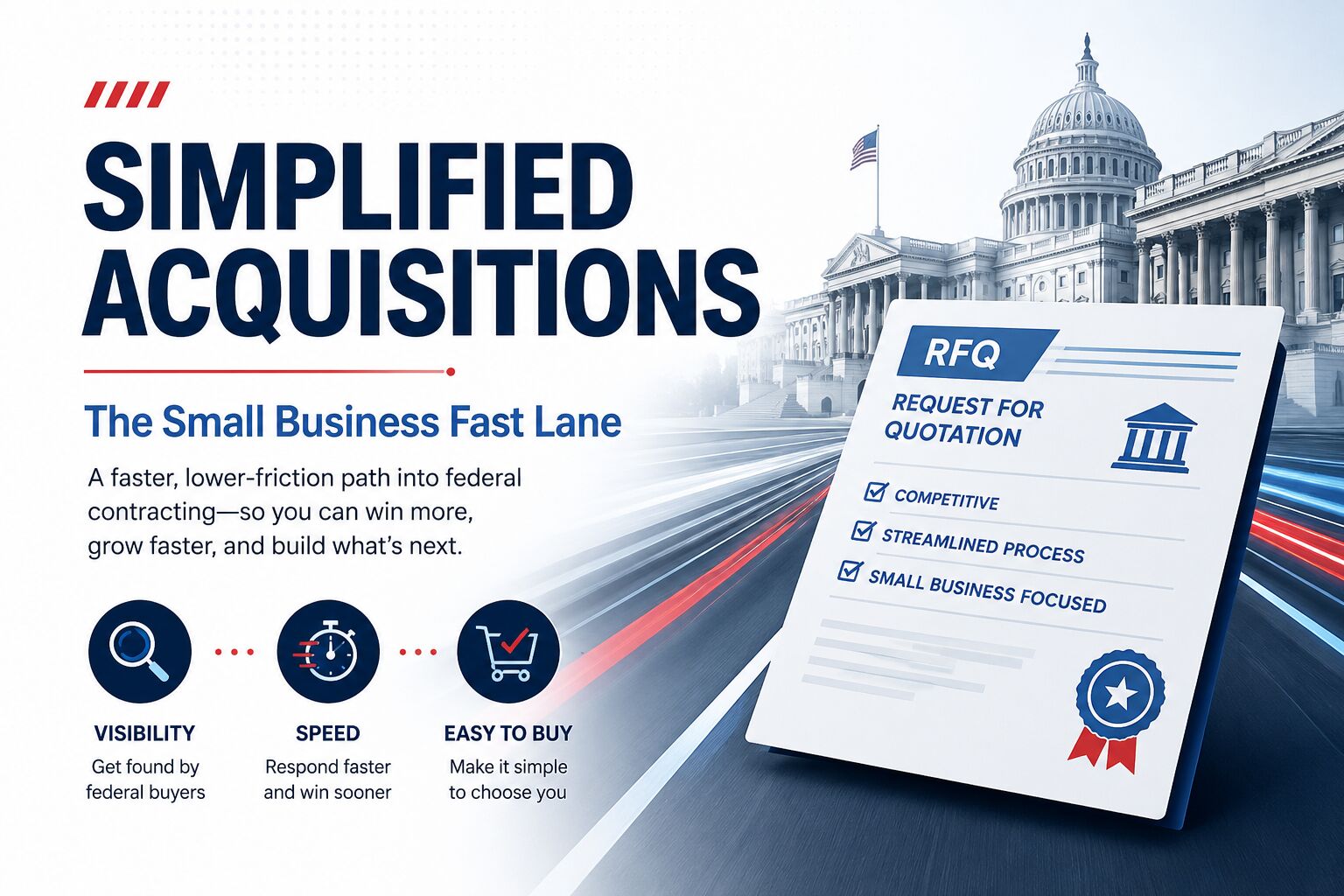
The Small Business Fast Lane: Why Simplified Acquisitions Deserve More Attention
Most new federal contractors are taught to search SAM.gov, find a large solicitation, and prepare a full proposal. That is one path into the market—but it is not the only one, and it is often not the best first path for a small business.
A quieter part of federal buying happens through simplified acquisition procedures. These purchases are designed to reduce administrative cost, improve efficiency, avoid unnecessary burdens, and expand opportunities for small businesses. The process is still competitive, but it is generally less complex than a large negotiated procurement.
For a company that is new to government contracting, simplified acquisitions can provide something especially valuable: a realistic way to build federal revenue, relationships, and past performance without betting weeks of effort on a single large proposal.
The opportunity is not simply “smaller contracts.” It is a different buying environment—one that rewards visibility, speed, clear pricing, and ease of purchase.
What Simplified Acquisition Really Means
The current Simplified Acquisition Threshold is $350,000 for most federal purchases. Below that level, agencies may use streamlined procedures rather than the more formal processes associated with larger procurements. The Federal Acquisition Regulation directs agencies to use simplified procedures to the maximum extent practicable when the requirement qualifies.
That does not mean every purchase is automatic, informal, or noncompetitive. It means the contracting officer has more flexibility in how the requirement is solicited, evaluated, documented, and awarded. Instead of a lengthy Request for Proposals, the agency may use a shorter Request for Quotations, request pricing from a limited number of qualified sources, or issue a combined synopsis and solicitation for a commercial product or service.
For small businesses, the practical difference is significant: fewer pages, shorter response periods, less proposal overhead, and more opportunities to compete based on responsiveness, price, availability, and demonstrated capability.
The Three Purchasing Lanes Small Businesses Should Understand
Micro-purchases. The governmentwide micro-purchase threshold is generally $15,000. The Governmentwide Commercial Purchase Card is the preferred method for these transactions. A formal solicitation may not be required, which means the buyer often relies on existing vendor information, online research, catalogs, prior relationships, and the ability to make a quick purchase.
Simplified acquisitions. Purchases above the micro-purchase threshold and at or below the $350,000 Simplified Acquisition Threshold normally require competition to the maximum extent practicable. Contracting officers may request quotations from a reasonable number of sources and may use shorter, more flexible evaluation methods than those used for large procurements.
Commercial product and service acquisitions. Commercial buying procedures can be streamlined even further. For certain commercial products and services, simplified procedures may be used above the standard threshold—currently up to $9 million in many cases. Agencies may also use a combined synopsis and solicitation, which compresses the public notice and solicitation into one document.
Why This Lane Is Especially Important for New Contractors
A new contractor may not yet have a long federal résumé, a large proposal team, or multiple government references. Simplified acquisitions can provide a more manageable starting point.
A smaller first award can help a company learn how the agency communicates, invoices, accepts deliverables, manages performance, and evaluates vendors. It can also generate the federal past performance and buyer confidence needed to pursue larger work later.
Just as important, smaller purchases often support recurring operational needs. A company that performs well may become a familiar and dependable source for future requirements, especially when the buyer needs the same product or service again.
Visibility Matters More Than a Long Proposal
In the simplified acquisition environment, buyers may be searching for vendors before a formal opportunity is widely visible. FAR Part 13 identifies SAM.gov as a primary source of vendor information, and many offices also maintain local source lists, vendor directories, acquisition forecasts, purchase card resources, or internal market research files.
That changes how a small business should think about its capability statement. The document is not only a marketing handout. It is also a search tool. It should contain the exact language a government buyer would use to describe the requirement, including relevant services, products, NAICS codes, geographic coverage, contract vehicles, certifications, and differentiators.
A beautiful capability statement that does not use the buyer’s language may never be found. A clear, keyword-rich capability statement can help a contracting officer or program office quickly determine whether the company belongs on the source list.
Speed Becomes a Competitive Advantage
Simplified acquisitions often move quickly. A business that needs several weeks to assemble pricing, confirm availability, gather past performance, and prepare basic documents may lose before it ever submits a quote.
Federal-ready companies should maintain a quotation package that can be tailored rapidly. At a minimum, that package should include concise pricing, a clear scope or product description, delivery or performance timelines, payment terms, applicable assumptions, points of contact, and relevant experience.
The goal is not to overwhelm the buyer. The goal is to remove questions and make the purchase easy to evaluate. In this lane, clarity and speed frequently matter more than volume.
Make Your Company Easy to Buy From
Small businesses should look at their federal positioning from the buyer’s side of the desk. Can the agency find the company? Can the buyer understand what it sells in less than a minute? Is pricing available? Can the company accept a purchase card? Is the SAM registration active and accurate? Can the company respond to a short RFQ without starting from zero?
A GSA Schedule, Blanket Purchase Agreement, or other established contract vehicle may help agencies buy more easily, but not every new business needs to begin there. The first step is understanding how the target agency normally purchases the specific product or service. Some offices buy through schedules, some through existing IDIQ contracts, some through local quotations, and some through purchase card transactions.
Contacting the agency’s Office of Small and Disadvantaged Business Utilization, Small Business Specialist, or contracting office can help clarify how vendors are located and whether the agency maintains a vendor portal or local source list.
A Practical Simplified Acquisition Readiness Checklist
· Your SAM.gov registration is active, complete, and aligned with the products or services you actually want to sell.
· Your capability statement uses federal buyer terminology and includes searchable keywords.
· You have a concise RFQ response template that can be customized quickly.
· Your pricing, delivery timelines, and standard terms are ready before the opportunity appears.
· You know whether your target agency uses purchase cards, local vendor lists, GSA Schedules, BPAs, or other contract vehicles.
· You have identified the contracting offices, small business specialists, and program offices that buy what you sell.
· Your website and online presence clearly explain your government-facing capability.
· You can provide relevant commercial or government past performance without delay.
The Bottom Line
Simplified acquisitions are not a shortcut around preparation. They reward a different kind of preparation.
The companies that succeed in this market are visible before the requirement is released, able to respond quickly, clear about what they provide, and easy for the government to purchase from. They understand that federal contracting is not only about winning large RFPs. It is also about becoming a dependable source for the everyday products and services agencies need to keep operating.
For many small businesses, the first federal win may not come from a large, highly publicized contract. It may come from a buyer who finds the right vendor, requests a quote, and needs a clear answer quickly.
The question is not simply whether your company is capable. The question is whether your company is ready to be found, evaluated, and purchased from when that opportunity appears.
Need help becoming simplified-acquisition ready? GovPreneurs helps small businesses strengthen their federal positioning, capability statements, buyer targeting, and response readiness.
Regulatory References
· Federal Acquisition Regulation, Part 13 - Simplified Acquisition Procedures (Acquisition.gov)
· Federal Acquisition Regulation, 13.201 - Micro-Purchases (Acquisition.gov)
· Federal Acquisition Regulation, 12.603 - Streamlined Solicitation for Commercial Products or Commercial Services (Acquisition.gov)
· Acquisition.gov, Threshold Changes Effective October 1, 2025